

Distracted Breastfeeding help

Did you know you can share the lactation love with other families? We recently received a gift of funds to allow us to provide services to women whose insurance doesn’t cover lactation services. For those with self pay as the only option, the repeated visits can be a financial burden for some. With the gifted funds, we can allocate amounts to clients to help partially or fully cover their visits. As always, we hope those who find paying for needed services to be a challenge would discuss options with us. Gifted funds make accommodating more clients possible!
Please contact us 859.832.0203 or lactationcarewithelizabeth@gmail.com if you’re interested in paying it forward.
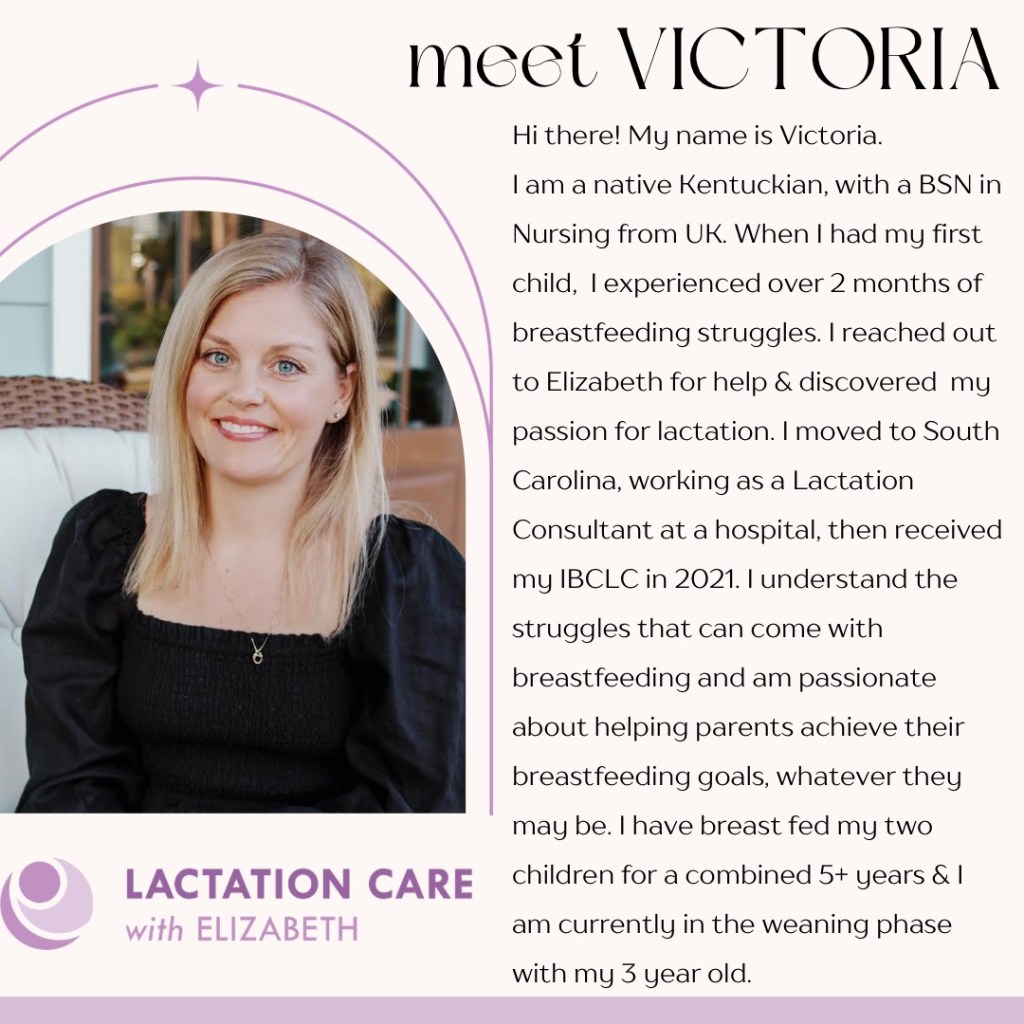
Here to support those breastfeeding in Kentucky, join us in welcoming our newest IBCLC at Lactation Care with Elizabeth!

Dr. Colby Cohen-Archer with The Postpartum Adjustment Center recommends these resources for mental health care for postpartum depression, anxiety & sleep disorders:
National Maternal Mental Health Hotline
1-833-TLC-MAMA (1-833-852-6262)
The National Maternal Mental Health Hotline provides 24/7, free, confidential support before, during, and after pregnancy. The Hotline offers callers:
Postpartum Support International https://www.postpartum.net/
Free Online Support Groups: https://www.postpartum.net/get-help/psi-online-support-meetings/ [Note that there are support groups for pregnancy, postpartum, as well as for parenting littles ages 1-4.]

Breast pain, clogs, mastitis- what to do when those boobs hurt? A summary and practical application of the Academy of Breastfeeding Medicine Protocol #36 on the Mastitis Spectrum.
Recent research and imaging techniques have led to new information on what happens in the breasts when there is pain and inflammation. Areas that feel like clogs are more general areas of inflammation, lymphatic congestion, and alveolar edema. So, there isn’t one duct with a clog of milk blocking it- that may be what it feels like, but that isn’t what imaging shows. As that area gets more inflamed, it is called inflammatory mastitis, and may have systemic symptoms like fever and chills. This may progress into bacterial mastitis, where there is an actual infection.
Other kinds of problems are phlegmons, abscesses, galactoceles (just milk galactoceles and alsoinfected areas), and subacute mastitis. These do require treatment by your doctor or midwife.
The good news is that inflammatory mastitis can be managed WITHOUT antibiotics! Instead, working to treat the symptoms, getting plenty of rest, and decreasing stress is the first line of care.
So how do we treat this early inflammatory issue?
1. Feed and pump to the baby’s needs. This means not doing lots of extra pumping to keep the breast drained, as was previously recommended as this increases milk production, and increases inflammation to the area. If your breast is so inflamed that there isn’t anything coming out, give it a rest (feed/pump on the other side), and work on healing.
2. Ice/cold on the affected areas.
3. Lymphatic drainage.
4. Be nice to your boobs: wear an appropriately fitted bra, use correct flange sizes, pump just as needed, don’t do deep massage- light lymph massage and gentle hand expression techniques only.
5. Take anti-inflammatory medications such as ibuprofen and sunflower lecithin/choline. (natural additions would be turmeric/curcumin and ginger.)
6. Therapeutic ultrasound reduces inflammation. We have many amazing pelvic floor physical therapists in the area who are trained to use their ultrasounds for this! Usuallythey like to do treatments several days in a row.
7. There is some research on the use of probiotics to help symptoms and prevent bacterial mastitis.
8. Check your mental health- post partum mood disorders (anxiety/depression) can go hand in hand with breast symptoms.
If symptoms persist, there may be a need for antibiotics as the inflammation could progress into bacterial mastitis. Contact your doctor or midwife if the above treatments are not effective after 24 hours.
If you want to read the entire protocol, or see all the cool imaging pictures, check it out here.

 Lactation Care with Elizabeth Stapleton, IBCLC